Total Pageviews

Thursday, March 14, 2019

Charleston Lowcountry Rose Society March 2019 Meeting

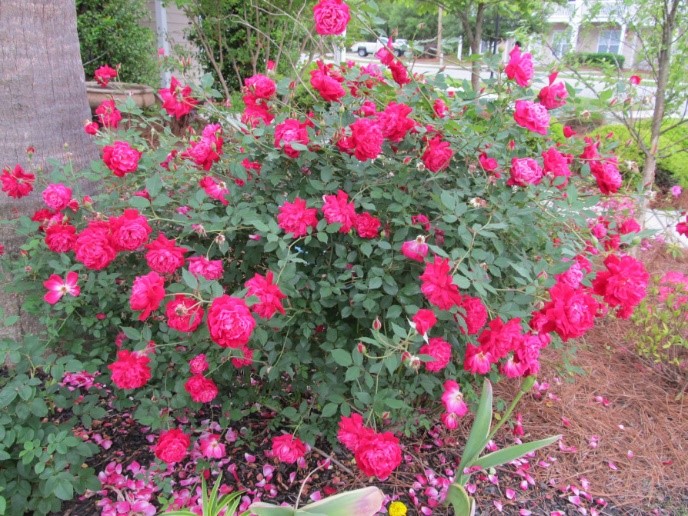
Cramoisi Superieur, a China Rose

The Charleston Lowcountry Rose Society will have their March meeting on Monday, March 18 with social at 6 pm and program at 6:30 pm at James Island Town Hall located at 1122 Dills Bluff Rd., James Island, SC 29412.
The program will be the China Rose which is the foundation species upon which all our modern roses are built, whether they be bedding or shrubs or perpetual-flowering climbers. It’s influence in rose-breeding over nearly two hundred years has been so great, so overwhelming, and so potent that it is difficult to see where we should have been without it. The most important characteristic of a China Rose is its ability to repeat bloom.
Here are a few of the China Rose that are still popular today.
  • Archduke Charles
  • Cramoisi SupĂ©rieur
  • Louis Philippe
  • Mutabilis
  • Old Blush
  • Perl d’Or’
  • Rouletii
  • Slater’s Crimson China
  • ‘The Green Rose’, R. viridiflora

Saturday, January 19, 2019

Drip Irrigation From A Surface Well


This article appeared on The Charleston Rose, the monthly newsletter of the Charleston Lowcountry Rose Society, Jan-Feb. 2013 issue, Editor - Rosalinda Morgan, contributed by William Prioleau, M.D.
Now, that it is getting chilly, it is time to tune up irrigation systems so that it will not be necessary to go out to water roses in the heat of the summer.
A farmer friend asked me to send him an account of how we irrigated. Here is what I am sending him.
A drip irrigation system from surface well, evolved over the years in our yard, is dependable, economical, and requires little maintenance.
Equipment
A one quarter or one half horsepower pump is adequate for gardens with 100 roses. The following irrigation equipment is available at ACE hardware stores: garden hose, water timer, filter, Y hose connector, adapter from the filter to one-half inch tubing, a roll of one half-inch tubing, a punch, a roll of one-quarter inch tubing, and an end plug.
Irrigation emitters that operate in the presence of sediment permit passage of four gallons of water an hour, have a plug that can be twisted or removed, and have a locking mechanism that keeps the plug securely in place. Such emitters are available from Peaceful Valley Farm and Garden Supply (GrowOrganic.com).
Assembly
A Y hose connector is attached to a pump. A garden hose is attached to each end of the Y. One hose goes to the filter and the roses. The other hose serves as a runoff for the pump. The flow in the runoff hose is adjusted so that the pump runs smoothly when the system is operating. Smooth running of the pump prevents wearing out of the check valve which occurs if a pump is allowed to turn on and off rapidly.
An emitter is placed in the irrigation line near the base of each plant. To each emitter is attached a length of one-fourth inch tubing the end of which is supported above the mulch so as to make flow of water visible.
A plug at the end of the irrigation line is left partially open so as avoid accumulation of sediment. If the plug is closed completely, small particles of sediment that pass through the filter will build up and close off the last two or three emitters in the line.
At 65 pounds per square inch a hose has enough pressure to eject small particles of sediment from twelve filters in a line. If one exceeds a ratio of one hose to twelve emitters, pressure may be insufficient to eject sediment from emitters when irrigation is initiated. With more than a dozen emitters, additional hoses with filters need to be added at points along the line to make a system dependable. If one adds too many emitters to a line, twisting of emitter plugs becomes necessary to initiate flow.
Maintenance
When a pump that has been running smoothly starts to go on and off, sediment has likely accumulated in the filters, and the filters need emptying. Batteries in present day timers need to be changed once a year. Other than that, little else is needed for a dependable watering system.

Wednesday, May 13, 2015

MAY IS ROSE MONTH IN THE LOWCOUNTRY


Roses, roses everywhere in the lowcountry!

 
Since roses are at their peak bloom in May in the Lowcountry, the Charleston Lowcountry Rose Society is celebrating May as their Rose Month instead of June.

 
Come to the local libraries (Photos below) at the Charleston area and see the Charleston Lowcountry Rose Society's display of members' roses together with brochures about growing roses, The American Rose magazines and some membership application forms for both the Charleston Lowcountry Rose Society and the American Rose Society. Not pictured are the displays at Mt. Pleasant, North Charleston and Goose Creek.
 
At Johns Island Public Library
 
At St. Andrews Regional Library
 
At West Ashley Library
 
At James Island Library
 
We will also have a booth at the Charleston Farmer’s Market on May 16 at Marion Square in downtown Charleston.  Here is the photo from last year's display.


To join the Charleston Lowcountry Rose Society, pick up an application form from the display at the libraries, or visit our website - www.charlestonrose.com. This year, we will have a special treat to our members - a picnic at a private plantation in Yemassee in June.

 Let’s have One Rose for Every Home!

Thursday, April 30, 2015

"Wine and Roses" Little Rose Show


COME AND JOIN US FOR OUR

LITTLE ROSE SHOW

Theme: “Wine and Roses”


Sunday, May 3, 2015

2:30 – 4:00 pm

Berkeley Electric Office

3351 Maybank Highway


The Rose Show is open to the public but only members of the Charleston Lowcountry Rose Society can enter the rose show. The membership dues are $15 per single membership and $20 per family membership and include 10 issues of our award-winning newsletter. For more info, check our website – www.charlestonrose.com


For our May meeting, we will not have a program but a Little Rose Show instead. The theme is “Wine and Roses”. Bring your roses if you can in an empty wine bottle with your name, the name of the rose and its rose classification. We limit ten entries per person. A couple can have 20 entries. All classes of roses can be entered including Knock Out roses. The roses are not going to be judged but all entries will have a prize just for bringing them in. Also, at the end of the show, we encourage our members to share their cuttings with fellow members and guests to take home to enjoy or root them or bring them to their local libraries for our “May is the Rose Month in the Lowcountry” project.


Tuesday, April 7, 2015

ROSE PHOTOGRAPHY CONTEST


At the Charleston Lowcountry Rose Society's Rose Show on April 25 at Cypress Gardens in Monck Corner, there is a section for ROSE PHOTOGRAPHY CONTEST. The Rose Show is open to the public from 1:00 - 4:30 PM. To enter the rose photography section, you have to be a member of the Charleston Lowcountry Rose Society. For info, go to our website: www.charlestonrose.com.


Below are the Classes and the Rules:  

Class 1: One bloom, at its most perfect stage, HT, Gr, F of any variety including singles, no sidebuds.

Class 2: One spray, FT, Gr, F, Polyantha, two or more blooms.

Class 3: One bloom of a miniature or miniflora, no sidebuds

Class 4: A spray of a miniature or miniflora

Class 5: One Bloom of Shrub or Old Garden Rose

Class 6: A spray of a Shrub or Old Garden Rose

Class 7: Open bloom rose(s) of any class, stamens must show.

Class 8: A photo of any rose garden or any rose society activitiy

Class 9: Abstract or Impressonism: A photo having non-objective design, form or content, of a rose plant(s) or any portion thereof. Does not include abstract arrangements.


Contest Rules:

1. Contest is open only to members of the Charleston Lowcountry Rose Society and must have taken all photographs entered. Any contestants who have not paid their current year’s dues will be ineligible.

2. Contestants are permitted to enter a maximum of three photographs per class in all classes. However, contestants may enter only one photo of a particular variety in ANY class. Photos can be in 4” x 6” or 5” x 7” size but no frame or matting is allowed.

3. Duplicate photos may NOT be entered in different classes.

4. The rose photos must be entered with the ARS approved exhibition name. Grooming the rose(s) is encouraged and artificial backgrounds may be used.

5. Photographs need to be submitted in the following format: class number with the letters a-c for multiple pictures in the same class, last name of the contestant and the approved exhibition name of the rose. An example would be 1a-Morgan – Gemini; 1b-Morgan – Queen Elizabeth; 1c-Morgan – Betty Boop. Tag should be taped in back of the photo. Any text in front of the entry will be cause for disqualification.

6. Any photographs may be enhanced by the use of any graphic program, such as Photoshop, Elements or Photo Impact.

7. Any individual who enters this contest give express permission to CLRS to use their photos for educational display at the libraries and at the Charleston Farmer’s Market in May. Photos will be returned to contestants in June.

8. Class 1-7 will be judged 50 percent on exhibition quality and 50 percent on photographic excellence. Class 8-9 will be judged on photographic excellence only.

9. The judges reserve the right to disqualify any entry that does not conform to the stated rules prior to the entries being judged.

10. There will be awards in each class: Blue ribbons for first place; Red ribbons for second place and Yellow ribbons for third place. The Blue ribbons winners in each class will be eligible for Best of Contest Award.
 

Sunday, March 15, 2015

FRAGRANT CLOUD


Photo from classicroses.co.uk
 
Registered Name – TANellis
Syns. Duftwolke, Nuage Parfume
Tantau, Germany, 1967
Seedling x ‘Prima Ballerina’


Fragrant Cloud rose has extremely fragrant blooms and constantly winning at rose shows across the country for its fragrance.  The flowers are an unuual coral-red maturing to geranium red with 30 petals and exhibition-style blooms.  The high-centered well-formed blooms are borne mostly singly, averaging 5”-6” in diameter on a vigorous upright plant of 3-5 ft in height and 2 ft in width.  The large foliage is a rich, glossy dark green on a vigorous bush that is very prolific.  I had Fragrant Cloud rose in my first garden in the early ‘70s and then again it was one of the first roses that were planted when we bought our next home in the ‘80s.  After 30 years, it was still there when we left. 

 
Fragrant Cloud rose is an excellent rose for bedding and for borders and cut flower.  It is very susceptible to mildew in autumn and black spot during damp weather.  Inspite of those problems, it still remains as one of the most popular roses in the market because of its intense fragrance.  You can bring them inside and fill the room with heady perfume for days. There is a climbing Fragrant Cloud propagated by Collin & Sons in England in 1973.  It also has that unique coral-red bloom on the long canes, covered with dark, reddish green foliage.  The climbing version can reach a height of 12 ft.  Fragrant Cloud climbing rose can produce very fragrant blooms during the summer only. 


Fragrant Cloud rose has won the National Rose Society President’s International Trophy in 1964, Portland Gold Medal in 1966, American Rose Society James Alexander Gamble for Fragrance Award in 1970 and World Favorite Rose in 1981 and still winning awards today for fragrance.

Tuesday, March 3, 2015

PRUNING YOUR ROSES


If you look at the calendar, Spring begins on March 20 but lovers of roses, spring comes when that yellow-flowered shrub called Forsythia starts to bloom.  Then our season begins.  But before we enjoy the fragrance and color of the rose garden, there's much work ahead with cleanup and pruning. Some rosarians start early which is not such a bad idea especially if you have plenty of roses to prune.   You can always cut more later but you have a head start.  Pruning our roses is a rite of spring for us.  

We prune our roses for several reasons – to keep our roses healthy, to control its excessive growth and to shape your bush for a better display.  

Before we rush out there in the garden, make sure you have all the right equipments.  A good pair of bypass pruner preferably Felco. No 2 is recommended. Keep your pruner very sharp.  A sharp pruner is less taxing to your hand and creates less bruising on your roses.  For cutting larger canes, a lopper is a better choice.  Their longer handles make it easier to cut through thicker canes.  You should also have a pruning saw for those extra thick canes.  

Also, of utmost importance is to wear gloves.  A good leather glove is a must to protect yourself from too many scratches.  Long sleeved shirts or jackets will protect your arms and wrists.  Hat is also important to protect your face from the sun and to protect your head if you are balding.  My favorite is a pith helmet.  Make sure your tetanus booster shot is up to date.

Your first agenda is to cut the dead, diseased and damaged canes. Cut until you see the white or cream colored pith.  If necessary, you can go down to almost near the bud union.  Roses will bloom on a dark colored pith but once the weather warms, the canes die back or become unproductive. Don’t go crazy looking for white pith on “Peace” rose.  It does not have white pith.  After getting rid of the dead and diseased canes, begin cutting the longer canes first and get them out of your way.  Pay close attention to what you are doing.  Work from the outside in.  Remember that you are surrounded with thorns so be very careful.  

Cut above the leaf with five leaflets to about ¼ inch from the bud.  If longer, the cane can die back and if shorter, new growth might break off in the wind.  Cut to an outward facing bud so a new growth will face outward too.  With few exception, like roses that tend to grow sideways, cut in the direction you want the branch to grow.  Roses like The McCartney Rose, First Prize and Just Joey tend to sprawl so prune them to an inside facing bud.    Always remember to aim at an open space in the bush.  Make the cut on a slant so water drain off.  Seal with Elmer’s glue to prevent the cane borer from burrowing into the newly cut canes.    

You also want to open the center of the bush for good air circulation to ward off diseases.  Cut long and straggly canes and canes that are crossing or touching each other leaving the stronger canes.  I usually cut to about a foot high except for the shrub types which can go from 18 inches to 24 inches tall.  Leave three or four good healthy canes.  If only one cane is available, cut it lower to encourage new growth from the bud union.

On Hybrid Teas, Grandiflora, and some Floribundas, remove stems smaller than a pencil because they will not produce good blooms for cutting.  For exhibitors, cutting back to 6 to 12 inches length will produce stronger canes and good quality blooms.  Miniature roses are pruned the same way as Hybrid Teas.  If you find this too tedious, you can go drastic and use a hedge pruner and prune to 5” high.  Mother Nature is very forgiving and usually corrects our mistakes so don’t worry too much.  Climbers and ramblers bloom from the 2-year old canes so cut the dead wood only and trim to desired shape.  Old Garden Roses also bloom from the second year wood so cut only the dead wood in spring and prune drastically after flowering to promote growth and improve its shape.  

Remove all blind shoots.  These are branches that taper down to almost nothing.  Remove spurs.  These are short growths only a few inches long that have hardened off and taper down to a point.  They will not flower.  

Prune to desired height you want for your rose.  Some rosarians want their roses tall.  I want my roses short and compact looking.  I can also look down at them instead of stretching my neck to appreciate their beauty.  After you are done pruning, remove every leaf.  These old leaves are the reservoir for black spot and mildew.  You might also want to start your spraying program with dormant oil to take care of the overwintering insects.  Also, spread a cupful of Epsom salt around each bush for better growth.  Then you can relax a little bit while waiting for the new growth to arrive.