Total Pageviews

Sunday, April 27, 2014

Charleston Lowcountry Rose Society May Meeting

Charleston Lowcountry Rose Society will hold their next meeting on Sunday, May 4, 2014 at 2:30 PM at Berkeley Electric Cooperative Office, 3351 Maybank Highway, Johns Island, SC 29455.

On Sunday, May 4, 2014, Sandy Lundberg will give a lecture on "How to Show a Rose at its Best: Tips and Tricks from a Master Rose Grower and Show Winner".

Our speaker for the May Meeting, Sandy Lundberg, writes the monthly column, “From Sandy’s Garden” in The Charleston Rose, the monthly newsletter of Charleston Lowcountry Rose Society. Sandy was a Past President of CLRS, an American Rose Society Master Rosarian and Accredited Judge of the American Rose Society. She and her husband, Bob, maintain a rose garden of about 400 roses in Blufton, SC. She is one of the top rose exhibitors in the country, having won so many awards at the local rose shows, the district level and the national rose shows. She will show us how to groom our roses for the rose show which will be on May 10 at the Citadel Mall. She will bring her tool box with her and teach us all her tricks. If you plan to exhibit, this is one program you do not want to miss.
 
Membership in the Charleston Lowcountry Rose Society is open to anyone with interest in roses. Dues are $15 for single membership and $20 for family membership annually, January - December and includes information-packed newsletter, The Charleston Rose and participation in all society activities.
 
For more info, email Rosalinda Morgan at RosalindaRM@comcast.net. To join, send dues to Matthew Morgan, Membership Chair, 3056 Sugarberry Ln., Johns Island, SC 29455.

 Visit our website – www.charlestonrose.com.

Saturday, April 19, 2014

Preparing Winners in the Garden and at the Show!


This Article by Sandy Lundberg, a Past President of the Charleston Lowcountry Rose Society won an Award of Merit from the American Rose Society in the 2013 ARS Newsletter/Bulletin competition, announced recently in the American Rose Magazine, May/June 2014 issue.
 
     May 11, 2013-----Show time for the Charleston Rose Society.  This spring has been a challenge for growers.  Last year the roses came two weeks early and this year they are two weeks late!
 
For novice or inexperienced exhibitors, the question is "what do I need to do to win"?  Many new exhibitors will try to bring everything they can from the garden and hope that they will get lucky.  Experienced exhibitors will advise you that in order to win, only the best quality roses should be entered and then the time that would have been spent trying to enter a large volume of roses, can be used to work on further improving the best specimens that you have.
 
What can be done in the garden?
     Improvements to your roses can start in the garden.  Often a bloom will be bent because it stayed attached to one of the sepals.  Gently pull the sepal loose and attach a small dowel stick just under the small bud.  Wrap the stick tight to the stem with parafilm or plastic bread wrapper material cut in strips.  Crooked stems can be gradually straightened by the same method.  Pale foliage can be darkened by using Sequestrine or Sprint 330 at the rate of 1 tablespoon per big bush or 1 teaspoon per miniature rose bush.  Continue to cut side growth early in its development so that you leave only about a 1/4 to 1/2 inch.  Do remember to pop these out at the show!  Potential sprays that you forgot to remove the center bud from can sometimes be pulled together with some yarn while growing and storing so that the gap will fill in.  Mist with Orthene WP at the rate of 1 tablespoon per gallon every two or three nights to prevent thrip damage.  This must be started as soon as the sepals begin to part on the blooms and show color.   Many exhibitors like to fertilize with a bloom builder formulation a couple of weeks before the show.  Wal-Mart and K-Mart carry Green Light Super Bloom 12-55-6 or you can continue to use Miracle-Gro.  Some exhibitors will also use fish emulsion for enhancing the color.  Don't forget to keep up your regular spray program and watch for spider mites.  They usually are present in our Lowcountry gardens by the third or fourth week of April.
 
     Watering should be done every day the week before the show.  It is the moisture in the petals that enables the rose to form starch in those petals.  Without this moisture to create substance in the petals, the rose will not last and will become limp.  Cutting the stem again at the show before putting it in the vase will also allow the rose to take up water to the petals enabling it to last longer.
 
 What is the ideal winning entry? 
     The ideal entry will be on a long, straight stem, free of insect and/or disease damage, both in the flower and foliage.   Since "form" is the most important factor in judging a rose, only roses with good form should be entered.  If a rose displays more than one point in the center (split centers) or "bull noses" (where a portion of the inner petal has folded over making a curved center), these are not worth entering.  The rose should exhibit exhibition form, which means that the center of the bloom should spiral to a high point and the rows of petals are evenly spaced out from the center.  Size, although given only 10 points on the judging scale, usually becomes very important in selecting the Queen.  With other factors being equal, generally the larger bloom will win Queen of Show.  Of course, old garden roses exhibit characteristics different from hybrid teas, floribundas and minis.   The foliage should be evenly spaced, undamaged, and not twisted. 
 
How and when should the roses be cut?
     The ideal time for cutting blooms is early morning or early evening when the rose has a lot of moisture, but roses do not always reach their ideal cutting stage at these times.  If a bloom is ready in the middle of the day, go ahead and cut it.  Just bring it into the cool house right away.  As you cut, place the blooms in a bucket of warm water.  Do not cram too many in the bucket at one time as you may tear some of the foliage.  Cut enough stem length to allow for a re-cut for conditioning and one at the show, but try not to rob the plant of more leaves than necessary.  If you have access to refrigeration, blooms can be cut mid-week, although some varieties will hold even longer in refrigeration.  You should experiment with your roses to see how many days various varieties will last.
 
How should the roses be conditioned and stored?
     After washing the foliage with warm, soapy water to remove any spray residue, place the bloom in a bucket of warm water, preferably up to the neck for a period of 1 1/2 to 2 hours to "harden off" for large roses.  "Harden off" minis and minifloras for 30 minutes and I like to “harden off” big roses for about an hour before refrigeration.  Then place in conditioned water for refrigeration.  Crysal RVB or Flora-Life are good for this.  In order to save time on the morning of the show, it is a good idea to polish the leaves and trim any damaged foliage right before refrigerating the rose. Trim any oversized sepals and check under the leaves for insect eggs.    Do not trim any petals on the bloom until the morning of the show, otherwise they will bruise.
 
What other things can be done before the show?
     The more you can do ahead of time, the more time you will have in the prep room to work on enhancing your roses.  Study the show schedule and try to decide in general terms those categories you want to enter based on what you believe will be available from your garden.  Remember the rule of thumb: If a bud isn't showing color between the sepals on Sunday, it will not be ready for the show the following Saturday.  Fill out entry tags for all the varieties you plan to enter.  If you plan a large number of entries, it would be wise to place them in alphabetical order in a file box.  Fill in all the information except for section and class and exhibitor's number unless you can get the number in advance.  Make a list of the varieties you plan to take and look up the correct spelling in the 2013 Handbook for Selecting Roses or The Combined Rose List.  The name printed in boldfaced type is the exhibition name that must be used.  If you are afraid you will forget the name of your roses, attach some kind of tag with the name on it to the rose.  But, remember to remove those identification tags before entering the rose. 
 
How do you prepare roses for entry to the best advantage?
     If you have had to transport your roses to the show in a cooler, you need to get them set into vases and allow at least 30 minutes for them to warm up before attempting to do necessary grooming such as opening up ones that are too tight with Q-tips.  During this time, you can be selecting and putting miniatures and floribundas, etc. into vases and putting entry tags on them.  Check each hybrid tea for the short stubs you left when you cut off the emerging side growth.  They should pop out easily.  If not, use a sharp knife to cut them being careful to not cut the foliage beneath.  Work the opening of hybrid teas gradually row by row.  Once you have the Queen, Miniflora Queen and Mini Queen contenders well under way, then you can look at the rest of the roses for possibilities for other classes such as collections, English boxes, floating bloom in a bowl, etc.  For collections, try to match the bloom size as closely as possible.  For full open entries make sure the stamens show and are fresh and that the bloom presents a circular outline.  Sprays should form a curved appearance with no blooms sticking above the plane and no large gaps in the spray.  Old garden roses should be fresh and exhibit the characteristics of that particular variety. 
 
     Exhibiting can be challenging and a great deal of fun.  If you have preplanned it will keep you from feeling rushed and making mistakes.  So, bring your best roses to the show and plan to win!
 

Wednesday, April 2, 2014

Charleston Lowcountry Rose Society April 2014 Meeting


Charleston Lowcountry Rose Society will hold their next meeting on Sunday, April 6 at 3 PM at Berkeley Electric Cooperative Office, 3351 Maybank Highway, Johns Island, SC 29455.


On Sunday April 6, 2014, there will be a Power Point presentation on how to Identify and control the common diseases and pests of roses in the Lowcountry given by Claude Thomas, Ph.D. Questions are welcome after the lecture.


Dr. Claude Thomas is a past Charleston Lowcountry Rose Society President and an American Rose Society Consulting Rosarian. He received his A.B. in Biology from Wofford College and his M.S. and Ph.D. degrees in Plant Pathology from Clemson University.  He was employed by the USDA, Agricultural Research Service, first as a Research Plant Pathologist, Subtropical Agriculture Research Laboratory, Weslaco, TX; then as Research Plant Pathologist and Research Leader/Laboratory Director at the U.S. Vegetable Laboratory, Charleston, SC. Dr. Thomas authored or co-authored some 200 scientific research publications on foliar fungal diseases of cucurbit and crucifer crops. He and his wife, June, enjoy growing and showing their roses and have won numerous awards at the local and district rose shows and the Coastal Carolina Fair.

 
Membership in the Charleston Lowcountry Rose Society is open to anyone with interest in roses. Dues are $15 for single membership and $20 for family membership annually, January - December and includes information-packed newsletter, The Charleston Rose and participation in all society activities.

 
For more info, email Rosalinda Morgan at RosalindaRM@comcast.net. To join, send dues to Matthew Morgan, Membership Chair, 3056 Sugarberry Ln., Johns Island, SC 29455.
 

Visit our website – www.charlestonrose.com.

Saturday, March 15, 2014

THE GREEN ROSE


At the October 2013 meeting of the Charleston Lowcountry Rose Society, I won a unique rose, The Green Rose. It is an oddity and a conversation piece and people either like it or hate it. It is Viridiflora ‘Rosa Monstrosa’ otherwise known as Green Rose. Records say Green Rose has been in cultivation as early as 1743 and is a sport from Rosa Indica (The China Rose of England and the Daily Rose of America).

 
The Green Rose is a small plant that grows to 3’ tall and has few thorns. It can be grown in a pot, and is rarely out of “blooms”. The buds are small, oval, of soft bluish green color and the “blooms” are usually formed in clusters continually throughout the season and look wonderful. The petals of the bloom reverted back to leaves (petals are modified leaves) and it does not have reproductive organs. As you would expect from an Old Garden Rose, this one is fragrant too. It has a spicy fragrance. But unless you know what you’re looking for, it is hard to find the bud since the bush is totally green. 

 
For all the Irish in all of us, we can say we have a green rose, not St. Patrick which only has a tint of green, but a real green rose. So take pride, we have our own green to celebrate. Plant it and you might like it. It is a wonderful rose to use as a filler material in arrangements or as a landscape rose. But I’m sure some visitors to your garden will undoubtedly say “That’s not a rose!  You got to be kidding!!” or worst yet, “That is the ugliest flower I’ve ever seen. Why do you give it space?”

“May the sun shine warm upon your face
And
May the rains fall softly upon your rose beds.”

 Happy St. Patrick’s Day!!!
 

Wednesday, March 5, 2014

NOISETTE ROSES


Marechal Niel
Photo taken at Rosalinda's Garden in Charleston, SC


The Noisette roses, a class of old garden roses, was the first class of roses bred, evaluated and introduced to the world by the United States. The Noisette class started in Charles Town (Charleston), South Carolina by John Champneys. John Champneys was the son of a well-to-do loyalist who decided to remain loyal to England during the revolutionary war and was forced to flee back to London after Charles Town fell. His estate at that time was worth around 20,000 pound sterling. After the war he tried to return to Charles Town but was not received with open arms. Being forced to flee back to England he was able to seek restitution for his estate for only 5,000 pound sterling. On his way back to Charles Town for the second time, his ship had been hijacked twice and in the process he lost two family members.

When he finally made it back to Charles Town he was not able to get the family estate back. He did purchase a piece of property just down the river, which had a well-known pleasure garden. This is where he was landscaping, and hybridizing. Somewhere between 1800 and 1814, John Champneys crossed Rosa moschata ‘Musk Rose’ and Rosa chinensis ‘Old Blush’. The resulting seedling was called ‘Champneys’ Pink Cluster’. It was given to his friend and neighbor, Philippe Noisette whose family in France was in the nursery business and eventually hybridized a rose called Blush Noisette. Philippe sent cuttings to his brother, Louis Claude, who was running the family business in France. Pierre Joseph Redoute, the famous botanical artist included in his paintings of early 19th century roses one labeled “Rosa Noisettiana” and “Rosier de Philippe Noisette.” The name, Noisette, spread throughout the world by way of the painting. Philippe Noisette came to Charles Town from France by way of Saint-Dominque to work in America’s first botanical garden developed by the Medical College of South Carolina.

Noisette roses are very vigorous plant, with arching canes and include both bushes and climbers and are very sweet scented.  They are noted for their ease of maintenance. They require very little care and are very disease- and pest-resistant and drought tolerant. Noisettes produce small to medium-sized, double flowers with pastel colors and come in clusters and very fragrant flowers all summer long. Some can grow as high as 20 feet and can be trained to climb trees, pergolas or trained to wrap around pillars. They need plenty of room to spread out. Their most romantic quality is their nodding flowers looking downwards unlike the regular climbers whose blooms look upwards. They tolerate poor soil and light shade but flower better in full sun. Some are not hardy.

 Here is a list of widely known noisettes :

Aimee Vibert – 1828 - white
Alister Stella Gray – 1894 – light yellow
Blush Noisette – before 1817 – white
Celine Forestier – 1842 – light yellow
Champneys’ Pink Cluster – before 1810 – light pink
Crepuscule – 1904 – apricot blend
Lamarque – 1830 - white
Mme. Alfred Carriere – 1879 - white
Marechal Niel – 1864 – medium yellow
Mary Washington – before 1892 - white
Nastarana – 1879 – white
Princesse de Nassau – 1835 – light yellow
Reve d’Or – 1869 – medium yellow
The Charlestonian – 2000 – white
Triomphe des Noisette – 1887 – deep pink

Visit our website - www.charlestonrose.com
 
To join, check Charleston Lowcountry Rose Society


Friday, February 28, 2014

Charleston Lowcountry Rose Society March 2014 Meeting

The Charleston Lowcountry Rose Society will hold their next meeting on Sunday, March 2 at 3 PM at Berkeley Electric Cooperative Office, 3351 Maybank Highway, Johns Island, SC 29455.

The program will be on Planting and Fertilizing your Roses given by Dr. Fletcher Derrick Jr.

Dr. Fletcher Derrick has been growing roses for over 35 years and is an American Rose Society Master Rosarian and an Accredited Horticultural Judge. He was featured in Post and Courier few months ago. He also appeared on South Carolina ETV program "Making It Grow" discussing roses with Rowland Alston. Dr. Derrick is a Fellow of the American College of Surgeons with an active private practice in Charleston. In his spare time, he grows and takes care of his roses in his home garden. Aside from growing roses, he also paints roses in his spare time.

Membership in the Charleston Lowcountry Rose Society is open to anyone with interest in roses. Dues are $15 for single membership and $20 for family membership annually, January - December and includes information-packed newsletter, The Charleston Rose and participation in all society activities.

For more info, email Rosalinda Morgan at RosalindaRM@comcast.net. To join, send dues to Matthew Morgan, Membership Chair, 3056 Sugarberry Ln., Johns Island, SC 29455.
Visit our website – www.charlestonrose.com.

Monday, February 10, 2014

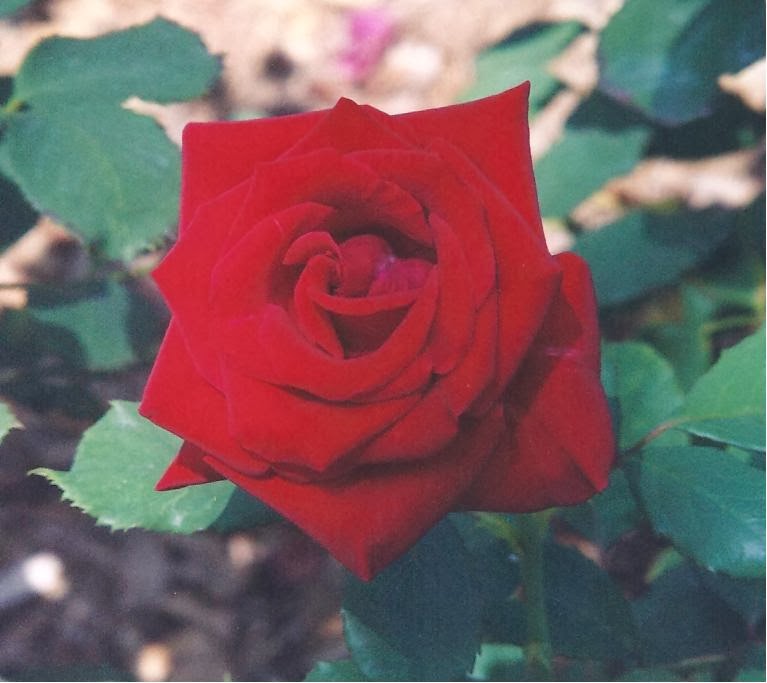
CUPID, RED ROSE AND VALENTINE


This month when we celebrate Valentine’s Day, it is interesting to note that the rose is not only a symbol of love but a symbol of discretion. Legend has it that Cupid gave a red rose to Harpocrates, the god of silence, to bribe him to secrecy over the dalliance of Venus and so the red rose become the symbol of discretion, love, passion and romance. Roses were henceforth painted on the ceilings of banquet halls to remind all gathered there that whatever was said there, should not be repeated which became the expression sub rosa (under the rose). Another legend says that while Aphrodite was running to the dying Adonis, she was scratched by a rose bush and her blood falling on the roses turn it red. Other account says that Adonis turned his blood into red roses.

Whatever legend strikes your fancy, there is nothing in our garden at this time of the year but the florist and even the supermarket stores are selling roses grown in South America so there is no excuse not to give red roses for Valentine’s Day. And how did Valentine’s Day get started?

A certain Bishop Valentine started it to replace the Roman festival of Lupercalia. There were several Bishop Valentines but nobody is really certain as to who is the real Bishop Valentine. But whoever he is, the tradition continues and we celebrate this day exchanging gifts and greetings between our loved ones, friends, family but mostly lovers.

During the Victorian era, valentine cards were mostly decorated with old-fashioned roses. Even today, valentines are still associated with roses. For Valentine’s Day, red roses are arbitrarily the most popular flower.

There are several red roses in the market nowadays but I can recommend some tried and true varieties that grow very well in the garden. Plant some of them and give your Valentine red roses again in June.

HYBRID TEA ROSES:

Carolina Pride – medium red rose

Firefighter – dark red rose

Ingrid Bergman – dark red rose

Lasting Love – dark red rose

Liebeszauber – dark red rose

Let Freedom Ring – medium red rose

Legends – medium red rose

Marilyn Wellan – medium red rose

Mister Lincoln – dark red rose

Mr. Caleb – medium red rose

Olympiad – medium red rose

Veteran’s Honor – dark red rose

 
FLORIBUNDA ROSES:

Drop Dead Red – dark red rose

Europeana – dark red rose

Lavaglut – dark red rose

Showbiz – medium red rose

Stadt den Helder – medium red rose

Super Hero – medium red rose

 
MINIATURE/MINIFLORA ROSES:

Black Jade – dark red rose

Memphis King – dark red rose

Old Glory – medium red rose

Power Point – medium red rose

Ralph Moore – medium red rose

Ruby Ruby – medium red rose

 
SHRUB ROSES:

Falstaff – dark red rose

Heathcliff – dark red rose

L. D. Braithwaite – dark red rose

Othello – medium red rose

Tess of the d’Urbervilles – dark red rose

The Prince – dark red rose